An archive of UX student portfolios
One of the things I've learned running the BSc UX Design course is that the work doesn't stop at graduation. Students spend three or four years with us developing their skills, building their portfolios, landing internships, and then they move on - but they are forever more part of our extended community, and it's amazing to see their careers take off, and to keep in touch.
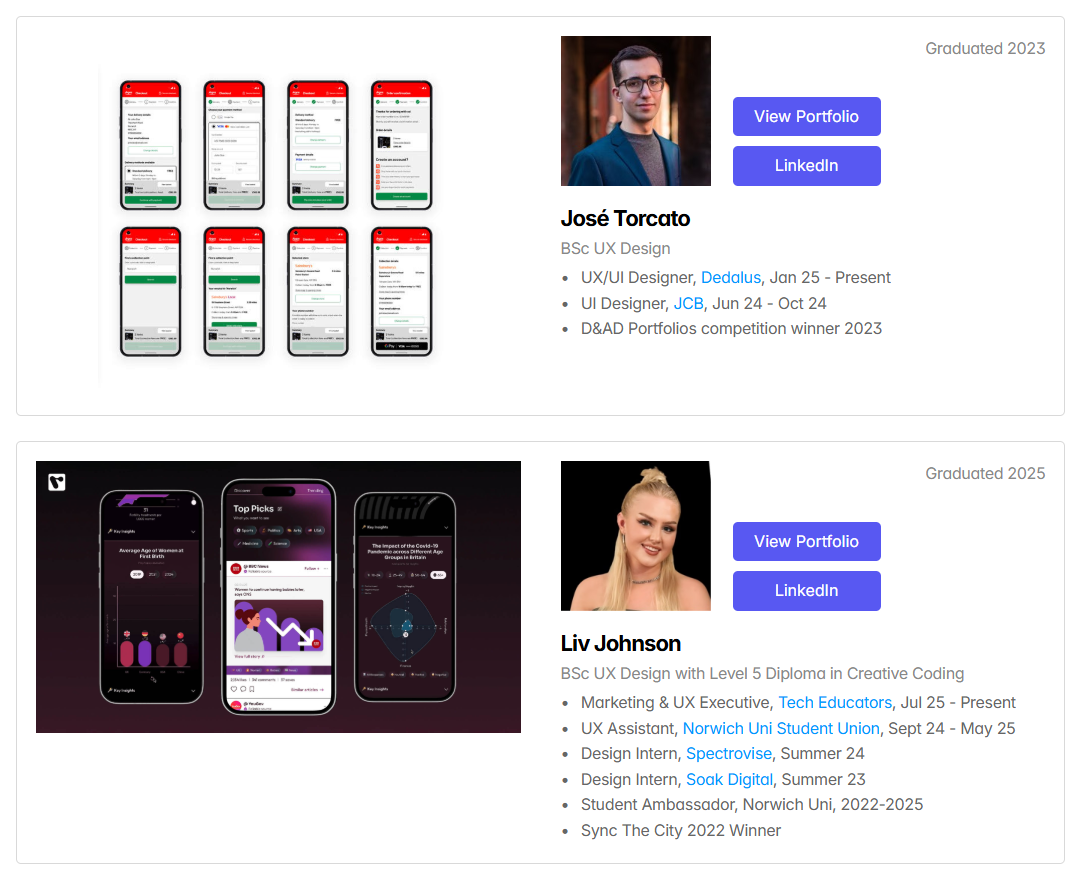
I wanted to build a space to celebrate their achievements and show off their best work. So I built norwichux.design — a place where you can browse BSc UX Design graduates portfolios, see where they've ended up, and get a sense of the kind of designers the course produces.
Student portfolio cards
The Problem It Solves
If you're an employer looking for UX talent, you may not know where to start with university graduates. You might check a course website and find some marketing copy, or you might find a student's portfolio through LinkedIn, but have no way of seeing it in context alongside their peers. We use the site at industry events and exhibitions to showcase the work and hepl employers and graduates find each other. And, if you're a prospective student trying to work out whether a UX course is good, your best evidence is what its graduates actually produce.
Why Framer?
I built the site in Framer, which gave me a few things I needed: a clean CMS for managing graduate records without touching code every time someone gets a new job, a flexible layout system that handles the card grid nicely, and fast deployment. It also means the site itself is a demonstration of the tools and platforms we teach on the course, and I can use it as a teaching tool in class.
Featured Portfolios and Resources
Beyond the full graduate list, there's a featured section that highlights standout work, useful for employers in a hurry, a reference point for current students looking for examples of best practice, and a nice bit of recognition for the students. There's also a resources page with some of the most valuable UX design references I point students toward during the course: Norman Nielsen Group, Laws of UX, the Coglode Behavioural Design System, Harry Brignull's Deceptive Patterns etc. It turns the site into something a bit more useful than just a directory, and attracts clicks through organic search.
The Bigger Picture
This started as a practical solution to a real problem — "how do I show people what our graduates can do?" — but it's turned into something I think has broader value. It's a recruitment tool for the course, an employability resource for graduates, and a reality check for me as a Course Leader. If the portfolios are strong, the teaching is working. If they're not, I need to look at what we're doing differently.
The 2025 cohort is up there, and some of the career trajectories are impressive. Max Barker went from Creative Conscience Grand Prix winner to Product Designer at Vogue, Condé Nast, London. James Hopper has already moved through internships at Tide and Athlon to a Junior Product Designer role at Yoti. Mara Cassidy is doing UX research for Amurabi and Fair Patterns in Paris.
I'll keep updating the site as graduates move through their careers. The plan is for it to become a long term record of what a UX design education can lead to and a hub for our community.
Browse the graduate portfolios at norwichux.design